
Call us for free consultation


A side-by-side can roll over at low speed, on terrain that looked manageable a second earlier. When it does, very little stands between the occupants and the ground: a roll cage, a seat belt, a door or net, and whatever the manufacturer decided was sufficient. When one of those fails, a crash that should have been survivable can leave someone paralyzed or dead.
UTVs occupy an unusual place in American life. They’re sold as recreation, used as farm and construction equipment, and driven by teenagers, ranch hands, hunters, and landscaping crews on ground that no passenger car would attempt. They also sit outside the federal safety rules that govern all-terrain vehicles, which surprises most families who learn it after a crash.
Langdon & Emison investigates accidents involving UTVs and side-by-sides, and has spent 40 years holding vehicle manufacturers accountable for defective designs. If you or a loved one was seriously injured in a UTV accident, call (866) 931-2115 for a free case evaluation.
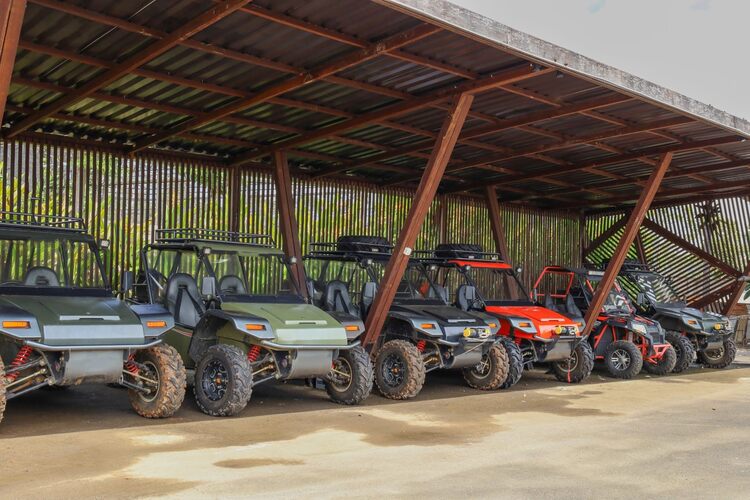
The distinction between a UTV and ATV determines which safety rules apply and which defect theories fit the vehicle.
A UTV, short for utility task vehicle, seats occupants side by side rather than astride, and it’s steered with a steering wheel and driven with foot pedals. Most carry a cargo bed. The Consumer Product Safety Commission notes that UTVs generally top out around 25 to 30 miles per hour and, unlike their recreational counterparts, “may not always be equipped with ROPS, seatbelts, and other safety restraints.”
CPSC uses “recreational off-highway vehicle,” or ROV, for the faster machines in this category: four or more wheels, non-straddle seating, a steering wheel, foot controls, and a top speed above 30 miles per hour.
All-terrain vehicles are a different machine. An ATV has a straddle seat and handlebars, carries no roll cage, and comes with no seat belts. ATV crashes and UTV crashes therefore produce different injury patterns and different claims, even when they happen on the same trail.
Rollover is the dominant hazard. Reviewing 801 in-depth investigations of fatal ROV incidents, CPSC staff found that more than two-thirds involved a rollover, and that more than 80 percent of those who died were ejected from the vehicle, either fully or partially.
That second number is the one that drives most defect litigation. A roll cage only protects an occupant who stays inside it. When a belt releases, a door swings open, or a barrier gives way, the roll cage passes over empty space while the occupant lands outside the vehicle or underneath it.
Emergency departments treated an estimated 14,800 injuries associated with UTVs and ROVs in 2023, according to CPSC’s most recent annual report, and the agency identified a statistically significant upward trend across the preceding five years. Survivors frequently face spinal cord injuries, traumatic brain injuries, crush injuries and amputations, burns from post-crash fires, and long-term disability that reshapes a family’s finances permanently.
This is where UTV cases differ from most vehicle cases, and it’s worth stating plainly.
ATVs are governed by a mandatory federal safety standard. UTVs and side-by-sides are not. CPSC opened a rulemaking in 2009 and proposed requirements in 2014 covering lateral stability and vehicle handling, along with an occupant retention provision that would have limited a vehicle’s speed to 15 miles per hour unless the front occupants’ seat belts were fastened. That rule was never finalized. On September 29, 2025, the Commission formally withdrew the rulemaking.
What governs these vehicles instead is a voluntary industry standard, ANSI/ROHVA 1, written by the manufacturers’ own trade association. Compliance isn’t required by law, and a manufacturer that meets it hasn’t thereby established that its vehicle was reasonably safe. In a product liability case, the absence of a binding federal standard can cut against the manufacturer rather than for it, because the design choices were the manufacturer’s own.
Federal recall records document the failure modes that recur in these vehicles. Each of the following reflects a defect CPSC has identified in a recalled UTV or side-by-side.
A recall isn’t required for a defect claim, and many defects are never recalled at all. Where a recall exists, it’s evidence about what the manufacturer knew and when, not a substitute for proving that the defect caused the injury.
More than one party is often involved, and identifying all of them early affects what a claim is ultimately worth.
The company that designed and built the vehicle may be responsible for a defect in the vehicle’s design or manufacturing, or for failing to warn about a known hazard.
Seat belts, latches, tires, and electrical systems are frequently built by other companies. A supplier whose component failed may bear responsibility alongside the vehicle manufacturer.
Property owners who allow UTV use on their land may be responsible for hazards they created or knew about and failed to address. Many states have recreational use statutes that limit landowner liability, so the analysis depends heavily on state law and on whether the rider paid for access.
Rental companies, outfitters, guided tour operators, and dealers offering demo rides can be responsible for renting out a poorly maintained machine, for inadequate instruction, or for putting someone on a vehicle they shouldn’t have been operating. Liability waivers are common in this setting, and they aren’t always enforceable.
UTVs are working equipment on farms, ranches, construction sites, and utility crews. A worker injured on the job generally can’t sue the employer directly, but workers’ compensation doesn’t bar a separate claim against a manufacturer, a property owner, an equipment supplier, or another contractor whose conduct contributed to the crash. Our personal injury attorneys handle those injury cases alongside the comp claim, because they reach damages that workers’ compensation doesn’t pay.
Proving a UTV defect takes more than reconstructing the crash. The vehicle itself is usually the most important piece of evidence, and it’s also the piece most likely to disappear.
If the machine is repaired, sold, scrapped, or returned to an employer or rental company, the belts, latches, welds, and roll cage that would establish what failed go with it. Our legal team moves to preserve the vehicle and its components before that happens.
A full investigation generally includes inspection of the failed components by qualified engineers, analysis of the manufacturer’s design and testing records, review of recall history and prior complaints involving the same model, examination of the scene and the terrain, and work with treating physicians to document the medical care and long term needs the injury created. Medical records, medical bills, the medical treatment still ahead, and life care projections establish what the injury has cost and what it will continue to cost. Insurance companies generally value these claims on what the file proves rather than on what happened.
Langdon & Emison is a national product liability firm that has recovered $1 billion in verdicts and settlements for its clients over 40 years of vehicle defect litigation. Our work includes a $23.4 million verdict for a driver left quadriplegic when a tire detreaded and his vehicle rolled over, and a $2 million verdict for the family of a man killed when an off-road machine without rollover protection overturned on him. Past results afford no guarantee of future results. Every case is different and must be judged on its own merits. Those who bring UTV cases are usually facing a manufacturer with substantial resources and a strong interest in attributing the crash to operator error.
A serious UTV accident raises questions that a routine accident claim doesn’t: whether the restraint system worked, whether the roll cage performed as designed, whether the doors held, and whether the vehicle should have been sold in that configuration at all. Those questions have to be answered before the vehicle is gone.
Langdon & Emison represents injured people and grieving families nationwide in vehicle rollover and wrongful death cases. Call us at (866) 931-2115 or contact us online to discuss what happened and what your options are.
Yes. Our firm handles ATV accident claims as well as UTV and side-by-side cases. The vehicles differ mechanically, so an ATV accident lawyer will evaluate a different set of defect and liability theories, but the investigation follows the same path.
Potentially. A recall is evidence, not a requirement. Many defects are identified through litigation rather than through a recall, and a vehicle can be defective whether or not the manufacturer or CPSC has acknowledged it.
Avoid repairing, selling, or disposing of it, and try to keep the vehicle and any failed parts in their post-crash condition. If it belongs to an employer or a rental company, tell a personal injury lawyer promptly so steps can be taken to preserve it.
Often, yes. The effect of not wearing a belt varies by state, and it’s frequently the first argument a manufacturer raises. It’s also worth investigating whether the restraint was usable and whether the vehicle’s design encouraged non-use. The answer is rarely as simple as the insurer suggests.
It can. CPSC advises that no one should ride in a side-by-side who can’t place both feet on the floorboard with their back against the seat, which is a fit test rather than an age cutoff. Whether a vehicle was suitable for a child passenger is often central to these cases.
The deadline depends on the state and on the type of claim, and product liability cases can involve additional rules about when the clock starts. Because missing the deadline can end a claim entirely, it’s worth speaking with a UTV accident lawyer right away rather than waiting for the investigation to conclude.