
Call us for free consultation


Fatigue-related truck crashes can be proven, even though there’s no roadside test for exhaustion the way there is for alcohol. Federal law requires motor carriers to keep electronic logs, and those records sit alongside engine data and fuel receipts that show when a driver should have been resting. Langdon & Emison has spent 40 years handling truck accident litigation across the country.
If you or a loved one has been injured by a fatigued truck driver, call (866) 931-2115 for a free consultation. A driver fatigue truck accident lawyer at our firm can explain what evidence still exists and how quickly it needs to be preserved.
Langdon & Emison is a personal injury law firm that tries cases against national motor carriers, and our attorneys have recovered more than $1 billion in verdicts and settlements over four decades.
Eight of our attorneys were recognized in the 2026 edition of The Best Lawyers in America, and Brett A. Emison was named Lawyer of the Year for Personal Injury Litigation for Plaintiffs in the Kansas City metro area.
Fatigue cases ultimately reward preparation. They turn on documents a trucking company controls and on testimony from records custodians who don’t volunteer much, so our driver fatigue accident lawyers handle that groundwork directly and prepare each case as though it will be tried.
Past trucking accident case results depend on the facts of each case and don’t predict what another claim will be worth. Among our results in cases involving commercial trucks:
We’re grateful for the trust our clients place in us, and we work hard every day to earn that trust by delivering the best possible legal representation.
| ⭐⭐⭐⭐⭐
“Langdon and Emison is such a reliable and greatly trusted law firm to have on your side. This firm holds nothing but true greatness when it comes to their lawyers, paralegals, and legal assistants.” —Lindsey |
| ⭐⭐⭐⭐⭐
“Ever since my accident, I felt like I had lost a sense of control in my life, and Langdon & Emison helped me take it back and look forward to the future, which is priceless.” —Venus |
| ⭐⭐⭐⭐⭐
“I couldn’t be more pleased with the way my case was handled.” —Linda |
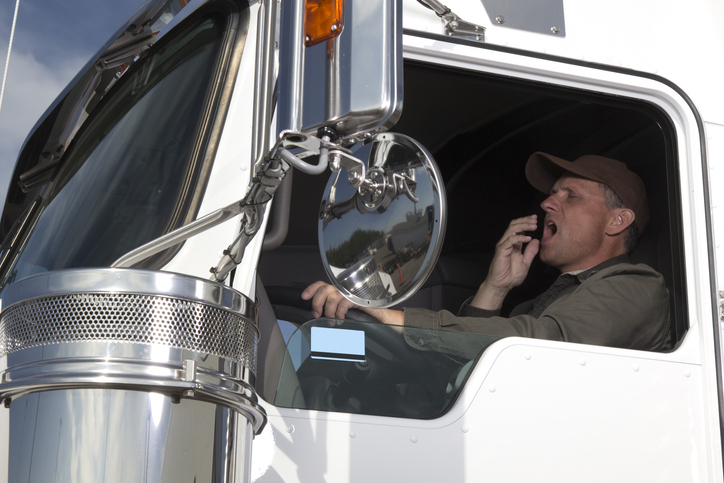
Fatigued driving impairs many of the same abilities alcohol does. A tired driver reacts more slowly, judges closing speeds poorly, and has trouble holding a lane. Fatigue also produces microsleep, a lapse into sleep lasting a few seconds. At 65 miles per hour, a truck covers about 95 feet every second, so a four-second microsleep carries it roughly 380 feet with nobody watching the road.
Weight makes that worse. A loaded tractor-trailer can weigh 20 to 30 times what a passenger car weighs and needs far more distance to stop. The Federal Motor Carrier Safety Administration counted roughly 503,000 police-reported crashes involving large trucks in 2022, including 5,279 fatal crashes and about 114,000 injury crashes.
Federal hours-of-service rules cap how long commercial truck drivers can stay behind the wheel. Every interstate property-carrying driver has to follow them:
Two exceptions matter. Drivers may split the 10-hour off-duty period using a sleeper berth if one period runs at least 2 hours and the other covers at least 7 consecutive hours in the berth, and they may extend the 11-hour limit and the 14-hour window by up to 2 hours in adverse driving conditions, which the hours-of-service regulations define narrowly.
Violating federal trucking regulations and their limits is evidence of negligence, and depending on the state and the facts, it can support a negligence per se claim, meaning the breach of a safety rule written to protect the public is established without a separate argument about what a reasonable driver would have done.
Fatigue is proven by contradiction. A driver can deny being tired, and a logbook can look clean, so the case gets built by lining up independent records and finding where the account stops holding together. In truck accident claims involving fatigue, that evidence usually includes:
Most of it has a relatively short shelf life. Carriers only have to retain records of duty status for six months, and video systems overwrite themselves in days. A driver fatigue accident attorney can send a spoliation letter putting the trucking company on formal notice not to alter or discard that material, which is why calling early matters more here than after an ordinary car crash.
More than one party is often responsible. Many states allow an injured person to seek compensation from the negligent parties whose conduct contributed to a crash, and accidents involving commercial trucks frequently reach past the driver.
Drivers are responsible for stopping when they’re too tired to continue safely, and may be liable for driving past federal hour limits, falsifying a logbook, or using stimulants to stay awake.
Trucking companies set the schedules their drivers work against. When a dispatcher builds a delivery window that can only be met by skipping a required break, the pressure to violate the rules comes from the company, and pay-per-mile pay adds to it because a stopped driver isn’t earning. A carrier may also be liable for negligent supervision if it never audited its own logs, and for negligent hiring if it put a driver on the road despite a record suggesting it shouldn’t have.
A freight broker or shipper may share responsibility when it sets a delivery window no compliant driver could meet. Liability turns on the contract terms and on how much control the company had over routing and timing.
Because serious trucking accidents involve both economic and personal losses, accident victims may be able to recover:
When a crash is fatal, eligible family members can bring a wrongful death claim for funeral costs, lost financial support, and loss of companionship.
Punitive damages are a separate question. They’re available only where the evidence meets a state’s standard for reckless or intentional misconduct, which usually means proof that a carrier directed hours-of-service violations or altered records. An isolated lapse by one driver generally won’t reach that bar.
Our goal in pursuing compensation is to recover the compensation you deserve under the law that applies. Every case turns on its own facts, and we work to document all of them so the recovery reflects the full extent of your losses.
Call 911 and get medical care the same day, because a gap between the crash and your first treatment gives an insurer room to argue the injuries came from something else. Photograph the vehicles, roadway, and skid marks while the scene is intact, and collect witness contact information plus the driver’s name, employer, insurer, and license number. Decline a recorded statement to the carrier’s insurer until you’ve talked with a lawyer, then contact a truck accident attorney while the electronic evidence still exists.
Related reading: What should I do if the trucking company contacts me after the accident?
Filing deadlines depend on the state and the type of claim. Make sure to talk to a lawyer to check the specific laws in your state, but contacting an attorney as quickly as possible usually makes for the best outcome.
If a fatigued truck driver injured you or someone in your family, Langdon & Emison is ready to review the case. Our attorneys have spent 40 years representing injured people across the country, and we handle these claims on a contingency fee basis, which means you pay no attorney’s fees unless compensation is recovered.
Call us at (866) 931-2115 or contact us online for a free consultation. Our driver fatigue truck accident attorneys can tell you what records need to be preserved and what deadlines apply.
Nobody can give an exact number, because fatigue leaves no physical trace. A driver rarely admits to it, and a police report is more likely to record the observable result, such as a lane departure or a failure to brake. The compliance data does show that recordkeeping violations are common: FMCSA’s 2024 Pocket Guide to Large Truck and Bus Statistics reports more than 60,000 roadside citations in 2023 for false reports of a driver’s record of duty status.
Yes. A driver who falls asleep at the wheel has failed to use reasonable care, and both the driver and the employer can be held liable. Under a rule called respondeat superior, a company answers for its employees’ negligence on the job. The company can also be responsible for its own decisions, including the schedule it set and how it supervised that driver.
A clean logbook is a starting point. Logs get compared against electronic logging, black box device data, GPS records, fuel and toll receipts, and shipping documents. A driver logged as off duty in Kingdom City at 2 a.m. who bought fuel outside Topeka at 3 a.m. has a problem no logbook entry resolves.